Published on Wednesday, April 25, 2007 by CommonDreams.org
Are Rove’s Missing E-mails the Smoking Guns of the Stolen 2004 Election?
by Bob Fitrakis and Harvey Wasserman
E-mails being sought from Karl Rove’s computers, and recent revelations about critical electronic conflicts of interest, may be the smoking guns of Ohio’s stolen 2004 election. A thorough recount of ballots and electronic files, preserved by a federal lawsuit, could tell the tale.The major media has come to focus on a large batch of electronic communications which have disappeared from the server of the Republican National Committee, and from White House advisor Rove’s computers. The attention stems from the controversial firing of eight federal prosecutors by Attorney-General Alberto Gonzales.
But the time frame from which these e-mails are missing also includes a critical late night period after the presidential election of 2004. In these crucial hours, computerized vote tallies may have been shifted to move the Ohio vote count from John Kerry to George W. Bush, giving Bush the presidency.
Earlier that day, Rove and Bush flew into Columbus. Local election officials say they met with Ohio Secretary of State J. Kenneth Blackwell in Columbus. Also apparently in attendance was Matt Damschroder, executive director of the Franklin County (Columbus) Board of Elections.
These four men, along with Ohio GOP chair Bob Bennett, were at the core of a multi-pronged strategy that gave Bush Ohio’s twenty Electoral College votes, and thus the presidency. Bennett and Damschroder held key positions on election boards in the state’s two most populous counties, with the biggest inner city concentrations of Democratic voters.
There were four key phases to the GOP’s election theft strategy:
1. Prior to the election, the GOP focused on massive voter disenfranchisement, with a selective reduction of voter turnout in urban Democratic strongholds. Blackwell issued confusing and contradictory edicts on voter eligibility, registration requirements, and provisional ballots; on shifting precinct locations; on denial and misprinting of absentee ballots, and more. Among other things, election officials, including Bennett, stripped nearly 300,000 voters from registration rolls in heavily Democratic areas in Cleveland, Cincinnati and Toledo.
2. On election day, the GOP focussed on voter intimidation, denial of voting rights to legally eligible ex-felons, denial of voting machines to inner city precincts, malfunctioning of those machines, destruction of provisional ballots and more.
In Franklin, Cuyahoga and other urban counties, huge lines left mostly African-American voters waiting in the rain for three hours and more. A Democratic Party survey shows more than 100,000 voters failed to vote due to these lines, which plagued heavily Democratic inner city precincts (but not Republican suburban ones) throughout the state. The survey shows another 50,000 ballots may have been discarded at the polling stations. In addition, to this day, more than 100,000 machine-rejected and provisional ballots remain uncounted. The official Bush margin of victory was less than 119,000 votes.
3. After the final tabulation of the votes, and the announcement that Bush had won, the GOP strategy focussed on subverting a statewide recount. A filing by the Green and Libertarian Parties required Ohio’s 88 county boards of election to conduct random precinct samplings, to be followed by recounts where necessary.
A lawsuit was filed to delay the seating of Ohio’s Electoral College delegation until after the recount was completed. Among other things, the plaintiffs sued to get access to Rove’s laptop. But Blackwell rushed to certify the delegation before a recount could be completed. The issue became moot, and the suit was dropped. In retaliation, Blackwell tried to impose legal sanctions on the attorneys who filed it.
But two felony convictions have thus far resulted from what prosecutors have called the “rigging” of the recount in Cuyahoga County (where Bennett has been forced to resign his chairmanship of the board of elections). More are likely to follow.
The practices that led to these convictions were apparently repeated in many of Ohio’s 88 counties. The order to violate the law—or at least tacit approval to do so—is almost certain to have come from Blackwell.
4. Ultimately, however, it is the GOP’s computerized control of the vote count that may have been decisive. And here is where Rove’s e-mails, and the wee hours of the morning after the election, are crucial.
Despite the massive disenfranchisement of Ohio Democrats, there is every indication John Kerry won Ohio 2004. Exit polls shown on national television at 12:20am gave Kerry a clear lead in Ohio, Iowa, Nevada and New Mexico. These “purple states” were Democratic blue late in the night, but, against virtually impossible odds, all turned Bush red by morning.
Along the way, Gahanna, Ohio’s “loaves & fishes” vote count, showed 4,258 ballots for Bush in a precinct where just 638 people voted. Voting machines in Youngstown and Columbus lit up for Bush when Kerry’s name was pushed. Rural Republican precincts registered more than 100% turnouts, while inner city Democratic ones went as low as 7%. Warren County declared a “Homeland Security” alert, removed the ballot count from public scrutiny, then recorded a huge, unlikely margin for Bush.
These and many more instances of irregularities and theft were reported at www.freepress.org and then confirmed by U.S. Representative John Conyers and others who researched the election.
But the most critical reversals may have come as exit polls indicated that despite massive Democratic disenfranchisement, and even with preliminary vote count manipulations, Kerry would win Ohio by 4.2%, a margin well in excess of 200,000 votes.
The key to that reversal may be electronic. It has now become widely known that the same web-hosting firm that served a range of GOP websites, including the one for the Republican National Committee, also hosted the official site that Blackwell used to report the Ohio vote count.
This astonishing conflict of interest has been reported at the epluribusmedia.org on-line investigative service. Cross-postings have come from luaptifer at Dailykos and blogger Joseph Cannon’s Cannonfire.blogspot.com. They all confirm that the RNC tech network’s hosting firm is SMARTech.com, based in Chattanooga, Tennessee. SMARTech hosts georgew.bush.com, mc.org and gop.com among other Republican web domains, in a bank basement.
Furthermore, the same hosting site that handled redirections from Blackwell’s “official” site also handled the White House e-mail accounts that have become central to investigations of the Gonzales purge of eight federal prosecutors, some of whom were themselves involved in vote fraud investigations.
Conflicts of interest in programming services and remote-access capability appear throughout the RNC’s computer networks, Rove’s secret White House e-mail, and the electronic vehicles used by Blackwell to finally reveal his “official” presidential vote counts for Ohio 2004.
One factor may be Ohio’s electronic touch-screen voting systems, on which were cast more than 800,000 votes in an election decided by about one-seventh that total. Such vulnerabilities, among other things, have been confirmed in exhaustive reports by Conyers’s Committee, by the Government Accountability Office, by the Carter-Baker Commission, by Princeton University, by the Brennan Center, and by others.
But overall, the electronic record of every vote in Ohio was transmitted to the Secretary of State’s office, and hosted in real time in Chattanooga. Under such circumstances, the joint hosting of the White House e-mail system and accessibility by Blackwell and Rove to the same computer networks linked to the Ohio vote count, takes on an added dimension.
Mike Connell, a Republican computer expert, helped create the software for both Ohio’s official 2004 election web site, and for the Bush campaign’s partisan web site during the 2000 election. The success of Connell’s GovTech Solutions has been attributed by Connell to his being “loyal to my network,” including the Bush family.
Blackwell shared those loyalties. Like Connell, he worked for the Bush-Cheney campaign, serving as its Ohio co-chair. He was also in control of the vote count that was being reported on software Bush loyalist Connell helped design.
It was in a crucial period after midnight on election night 2004 that these paired conflicts of interest may have decided the election. As exit polls showed a decisive Kerry victory, there was an unexplained 90-minute void in official reporting of results. By this time, most of the vote counts were coming in from rural areas, which are traditionally Republican, and which, ironically, usually report their results earlier than the Democratic urban areas.
In this time span, Kerry’s lead morphed into a GOP triumph. To explain this “miraculous” shift, Rove invented a myth of the greatest last-second voting surge in US history, allegedly coming from late-voting fundamentalist Republicans. No significant evidence exists to substantiate this claim. In fact, local news reports indicate the heaviest turnouts in most rural areas came early on election day, rather than later.
According to a January 13, 2005, release from Cedarville University, a small Ohio-based Christian academy, Connell’s GovTech Solutions helped make the shared server system run “like a champ…through the early morning hours as users from around the world looked to Ohio for their election results.”
After 2am, despite exit polls showing very much the opposite outcome, those results put Bush back in the White House.
In January, 2005, the U.S. Congress hosted the first challenge to a state’s Electoral College delegation in our nation’s history. At the time, the compromised security of the official Ohio electronic reporting systems was not public knowledge. But the first attempt to subpoena Karl Rove’s computer files had already failed.
Now a second attempt to gain such access is being mounted as the Gonzales scandal deepens.
Congressman Henry A. Waxman (D-CA) has raised “particular concerns about Karl Rove” and his electronic communications about the Gonzales firings.
Rove claims both his own computer records and the RNC’s servers have been purged of e-mails through the time the Ohio vote was being reversed. Rove’s attorney, Robert Kuskin, has told a Congressional inquiry that Rove mistakenly believed his messages to the RNC “were being archived” there.
But the RNC says it has no e-mail records for Rove before 2005. Rob Kelner, an RNC lawyer says efforts to recreate the lost records have had some success. But it’s not yet known whether communications from the 2004 election can be retrieved.
Nor is it known whether the joint access allowed to top GOP operatives Rove and Blackwell was responsible for the election-night reversal that put Bush back in the White House.
But there remains another avenue by which the real outcome of Ohio 2004 could be discovered. Longstanding federal law protected Ohio’s ballots and other election documentation prior to September 3, 2006. Blackwell gave clear orders that these crucial records were to be destroyed on that date.
Prior to the expiration of the federal statutory protection, a civil rights lawsuit was filed in the federal court of Judge Algernon Marbley, asking that the remaining records be preserved. The request was granted in what has become known as the King-Lincoln Bronzeville suit (co-author Bob Fitrakis is an attorney in the case, and Harvey Wasserman is a plaintiff).
Thus, by federal law, the actual ballots and electronic records should be available for the kind of exhaustive recount that was illegally denied—or “rigged,” as prosecutors in Cleveland have put it—by Blackwell, Bennett and their cohorts the first time around.
Ohio’s newly-elected Secretary of State, Jennifer Brunner, has agreed to take custody of these materials, and to bring them to a central repository, probably in Columbus.
This means that an exhaustive recount could show who really did win the presidential election of 2004.
It may also be possible to learn what roles—electronic or otherwise— Karl Rove and J. Kenneth Blackwell really did play during those crucial 90 minutes in the deep night, when the presidency somehow slipped from John Kerry to George W. Bush.
Bob Fitrakis & Harvey Wasserman are co-authors of HOW THE GOP STOLE AMERICA’S 2004 ELECTION & IS RIGGING 2008, available at http://www.freepress.org/ and, with Steve Rosenfeld, of WHAT HAPPENED IN OHIO?, from the New Press. Fitrakis is publisher, and Wasserman is senior editor, of http://www.freepress.org/ where this story was first published.
Sunday, April 29, 2007
missing emails may contain truth about 04 election fraud
Makes sense to me, these people are CRIMINALS and belong in prison making license plates instead of trashing our fine country.


Thursday, April 26, 2007
Walmart ; looking for a few good case officers.
creepy... I wonder why their needs can't be met by traditional business analyst types?
Wal-Mart recruits intelligence officers
By MARCUS KABEL
BW Exclusives
BENTONVILLE, Ark.
Wal-Mart Stores Inc. has been recruiting former military and government intelligence officers for a branch of its global security office aimed at identifying threats to the world's largest retailer, including from "suspect individuals and groups".
Wal-Mart's interest in intelligence operatives comes at a time when the retailer is defending itself against allegations by a fired security employee that it ran surveillance operations against targets including critics, dissident shareholders, employees and suppliers. Wal-Mart has denied any wrongdoing.
Wal-Mart posted ads in March on its own web site and sites for security professionals, including the bulletin of the Association of Former Intelligence Officers, for "global threat analysts" with a background in government or military intelligence work.
The jobs were listed with the Analytical Research Center, part of Wal-Mart's Global Security division, which is headed by former senior CIA and FBI senior officer Kenneth Senser. The analytical unit was created over the past year and half, according to published comments by its head, Army Special Operations veteran David Harrison.
The job description includes collecting information from "professional contacts" and public data to anticipate and assess threats stemming from "world events, regional/national security climates, and suspect individuals and groups."
"Familiarity with a broad spectrum of information resources and data-mining techniques" is listed among the skills sought, along with a foreign language, preferably Chinese or Spanish.
A Wal-Mart spokesman declined to comment on the Analytical Research Center for this story or to make any security executives available for interviews.
Many corporations hire law enforcement officers for their security departments.
But Steven Aftergood, who runs the government secrecy project for the Washington-based Federation of American Scientists, said Wal-Mart's efforts appear to go beyond what most companies are doing, raising questions about corporate intelligence work outside of the oversight process in place for government spying.
"It's a troubling new departure in corporate security. We're not just talking about security, we're talking about intelligence operations," Aftergood said.
Harrison told a meeting of security professionals last year that Wal-Mart was learning to defend itself by using the vast information it routinely collects about its employees, shoppers and suppliers.
The only public comment to date on the work of the Analystical Research Center, the speech was reported on by the trade magazine Government Security News. Wal-Mart did not dispute the report when contacted by The Associated Press this week.
Harrison told the meeting that Wal-Mart tracks customers including those who use its pharmacies, buy propane tanks and anyone making "bulk purchases" of prepaid cell phones, which some law enforcement officials have tied in the past to terrorist or criminal activities.
Harrison did not elaborate on how that information could be better used, except to say the data could be shared with law enforcement.
Wal-Mart's union-backed critics said culling customer data for intelligence was disturbing.
"The idea that Wal-Mart is creating its own personal CIA should make every American -- Wal-Mart customer or not -- nervous about whether Wal-Mart is invading their privacy or could do so in the future," said Chris Kofinis, spokesman for WakeUpWalMart.com.
Wednesday, April 25, 2007
Cheney's tax returns fail to mention deferred war profits!
This is what the White house reported as it was represented on Dick's 07 returns.
Only $504,150 is accounted for on this press release, on combined income of $1,614,862.
How about the "deferred compensation" from Halliburton? Has it run its course, or is the administration choosing to not mention it in this year's press release?
Typically it is nearly equivalent to Cnehey's salary as Vice President.
"In addition to his $190,134 government salary, Cheney earned $162,392 in deferred compensation from Halliburton Co., the Dallas energy services firm he headed until August 16, 2000."
- San Francisco Chronicle, April 12, 2003
"Vice President Dick Cheney received $178,437 in deferred pay last year from Halliburton Co., the Texas oil-field services company he once headed that has since received billion-dollar government contracts in Iraq ... Cheney reported $198,600 in vice-presidential salary for the year."
-Reuters/ CNN.com, April 13, 2004
In 2001, The US invaded Afghanistan. Halliburton support personnel went in first and built the infrastructure.
Cheney's Halliburton bonus and deferred compensation that year: $1,598,977
In 2002, Cheney agitated for the invasion of Iraq. Halliburton received an open-ended, no-bid contract to repair and rebuild Iraq's oil infrastructure.
Cheney's deferred compensation for 2002: $162,392
In 2003, the United States invaded Iraq. Security forces from Halliburton's subsidiary Kellogg, Brown and Root -- essentially a corporate mercenary operation -- were on the ground.
Cheney's deferred compensation for 2003: $178,437
Cheney's deferred compensation for 2004: $194,852
Cheney's deferred compensation for 2005: $211,465.
Cheney's salary as Vice President in 2005: $205,031.
The Cheneys' gross income for 2005, including exercised Halliburton stock options: $8,819,006
The Cheneys' 2005 tax refund after giving nearly $7 million to charity: $1,938,930
VICE PRESIDENT DICK CHENEY AND MRS. CHENEY
RELEASE 2006 INCOME TAX RETURN
Vice President and Mrs. Cheney filed their federal income tax return for 2006 today.
The income tax return shows that the Cheneys owe federal taxes for 2006 of $413,326 on taxable income of $1,614,862. During the course of 2006 the Cheneys paid $464,789 in taxes through withholding and estimated tax payments. The Cheneys elected to apply the resulting $51,463 tax overpayment to their 2007 estimated tax payments.
The wage and salary income reported on the tax return includes the Vice President’s $208,575 government salary. In addition, the tax return reports a pension benefit of $27,500, which the Vice President received as a former director of Union Pacific Corporation. The Vice President became eligible for this benefit in 2006 when he turned 65. The tax return also reports Mrs. Cheney’s book royalty income, which includes a partial royalty advance on a book she is writing about growing up in Wyoming. It also reports wage and salary income from her continuing work at the American Enterprise Institute and a pension benefit of $32,000, which she received as a former director of Reader’s Digest. The amounts of the pension benefits received by the Vice President and by Mrs. Cheney are fixed and will not increase or decrease based on changes in the earnings or revenues of either company.
The Cheneys donated $104,425 to charity in 2006. This brings the Cheneys’ total charitable contributions during his Vice Presidency to $7,800,019.
# # #
Only $504,150 is accounted for on this press release, on combined income of $1,614,862.
How about the "deferred compensation" from Halliburton? Has it run its course, or is the administration choosing to not mention it in this year's press release?
Typically it is nearly equivalent to Cnehey's salary as Vice President.
"In addition to his $190,134 government salary, Cheney earned $162,392 in deferred compensation from Halliburton Co., the Dallas energy services firm he headed until August 16, 2000."
- San Francisco Chronicle, April 12, 2003
"Vice President Dick Cheney received $178,437 in deferred pay last year from Halliburton Co., the Texas oil-field services company he once headed that has since received billion-dollar government contracts in Iraq ... Cheney reported $198,600 in vice-presidential salary for the year."
-Reuters/ CNN.com, April 13, 2004
In 2001, The US invaded Afghanistan. Halliburton support personnel went in first and built the infrastructure.
Cheney's Halliburton bonus and deferred compensation that year: $1,598,977
In 2002, Cheney agitated for the invasion of Iraq. Halliburton received an open-ended, no-bid contract to repair and rebuild Iraq's oil infrastructure.
Cheney's deferred compensation for 2002: $162,392
In 2003, the United States invaded Iraq. Security forces from Halliburton's subsidiary Kellogg, Brown and Root -- essentially a corporate mercenary operation -- were on the ground.
Cheney's deferred compensation for 2003: $178,437
Cheney's deferred compensation for 2004: $194,852
Cheney's deferred compensation for 2005: $211,465.
Cheney's salary as Vice President in 2005: $205,031.
The Cheneys' gross income for 2005, including exercised Halliburton stock options: $8,819,006
The Cheneys' 2005 tax refund after giving nearly $7 million to charity: $1,938,930
Tuesday, April 24, 2007
Marx Cafe Tonight!!
Hey all, join me tonight for a night of drinks and beats! It's going down at 9pm (or later) depends when I get up there. Going to want to get a decent meal before I start playing however so plan on 10pm, the Greek style lamb chops are pretty decent, big ups to the wienerschnitzel as well, it's all decent eats. BOH! See ya there.
3203 Mount Pleasant St. NW

3203 Mount Pleasant St. NW

Govt employees must pay own way!
Cancel the damn program if it's being so flagrantly misused. Why are govt employees more deserving than any other commuter? Are they a special class of workers? No, they are not, they are job slaves like any other and shouldn't be afforded special privileges. Instead take the mountain of cash being wasted on these office trolls and use it subsidize commuter travel for households earning less than $20K annually. That would put to good use what would otherwise be squandered thoughtlessly. What's next? Allowing govt employees to use HOV lanes?
GAO Finds Fraud in Commuter Programread the rest of the story...
Federal Workers Selling Transit Cards
By Lyndsey Layton
Washington Post Staff Writer
Tuesday, April 24, 2007; Page A01
It's a perk of federal employment: a free monthly subsidy that pays for commutes on public transportation. But scores of workers have been taking the government for a ride, selling their benefits on the Internet and pocketing millions in cash each year.
The program, which covers 300,000 federal employees nationwide, has been abused by workers across a variety of agencies, the Government Accountability Office will report to Congress today. Workers in the Washington region alone have defrauded the government of at least $17 million a year, with the actual figure probably several million dollars higher, according to the GAO.
Monday, April 23, 2007
Return to the gold standard?
Perhaps we should re-examine the gold standard as a way to prop up our failing Dollar internationally.
Gold and Economic Freedom
by Dr. Alan Greenspan, 1966This article originally appeared in a newsletter called The Objectivist published in 1966
and was reprinted in Ayn Rand's "Capitalism: The Unknown Ideal"
An almost hysterical antagonism toward the gold standard is one issue which unites statists of all persuasions. They seem to sense - perhaps more clearly and subtly than many consistent defenders of laissez-faire - that gold and economic freedom are inseparable, that the gold standard is an instrument of laissez-faire and that each implies and requires the other.In order to understand the source of their antagonism, it is necessary first to understand the specific role of gold in a free society.
Money is the common denominator of all economic transactions. It is that commodity which serves as a medium of exchange, is universally acceptable to all participants in an exchange economy as payment for their goods or services, and can, therefore, be used as a standard of market value and as a store of value, i.e., as a means of saving.
The existence of such a commodity is a precondition of a division of labor economy. If men did not have some commodity of objective value which was generally acceptable as money, they would have to resort to primitive barter or be forced to live on self-sufficient farms and forgo the inestimable advantages of specialization. If men had no means to store value, i.e., to save, neither long-range planning nor exchange would be possible.
What medium of exchange will be acceptable to all participants in an economy is not determined arbitrarily. First, the medium of exchange should be durable. In a primitive society of meager wealth, wheat might be sufficiently durable to serve as a medium, since all exchanges would occur only during and immediately after the harvest, leaving no value-surplus to store. But where store-of-value considerations are important, as they are in richer, more civilized societies, the medium of exchange must be a durable commodity, usually a metal. A metal is generally chosen because it is homogeneous and divisible: every unit is the same as every other and it can be blended or formed in any quantity. Precious jewels, for example, are neither homogeneous nor divisible. More important, the commodity chosen as a medium must be a luxury. Human desires for luxuries are unlimited and, therefore, luxury goods are always in demand and will always be acceptable. Wheat is a luxury in underfed civilizations, but not in a prosperous society. Cigarettes ordinarily would not serve as money, but they did in post-World War II Europe where they were considered a luxury. The term "luxury good" implies scarcity and high unit value. Having a high unit value, such a good is easily portable; for instance, an ounce of gold is worth a half-ton of pig iron.
In the early stages of a developing money economy, several media of exchange might be used, since a wide variety of commodities would fulfill the foregoing conditions. However, one of the commodities will gradually displace all others, by being more widely acceptable. Preferences on what to hold as a store of value, will shift to the most widely acceptable commodity, which, in turn, will make it still more acceptable. The shift is progressive until that commodity becomes the sole medium of exchange. The use of a single medium is highly advantageous for the same reasons that a money economy is superior to a barter economy: it makes exchanges possible on an incalculably wider scale.
Whether the single medium is gold, silver, seashells, cattle, or tobacco is optional, depending on the context and development of a given economy. In fact, all have been employed, at various times, as media of exchange. Even in the present century, two major commodities, gold and silver, have been used as international media of exchange, with gold becoming the predominant one. Gold, having both artistic and functional uses and being relatively scarce, has significant advantages over all other media of exchange. Since the beginning of World War I, it has been virtually the sole international standard of exchange. If all goods and services were to be paid for in gold, large payments would be difficult to execute and this would tend to limit the extent of a society's divisions of labor and specialization. Thus a logical extension of the creation of a medium of exchange is the development of a banking system and credit instruments (bank notes and deposits) which act as a substitute for, but are convertible into, gold.
A free banking system based on gold is able to extend credit and thus to create bank notes (currency) and deposits, according to the production requirements of the economy. Individual owners of gold are induced, by payments of interest, to deposit their gold in a bank (against which they can draw checks). But since it is rarely the case that all depositors want to withdraw all their gold at the same time, the banker need keep only a fraction of his total deposits in gold as reserves. This enables the banker to loan out more than the amount of his gold deposits (which means that he holds claims to gold rather than gold as security of his deposits). But the amount of loans which he can afford to make is not arbitrary: he has to gauge it in relation to his reserves and to the status of his investments.
When banks loan money to finance productive and profitable endeavors, the loans are paid off rapidly and bank credit continues to be generally available. But when the business ventures financed by bank credit are less profitable and slow to pay off, bankers soon find that their loans outstanding are excessive relative to their gold reserves, and they begin to curtail new lending, usually by charging higher interest rates. This tends to restrict the financing of new ventures and requires the existing borrowers to improve their profitability before they can obtain credit for further expansion. Thus, under the gold standard, a free banking system stands as the protector of an economy's stability and balanced growth. When gold is accepted as the medium of exchange by most or all nations, an unhampered free international gold standard serves to foster a world-wide division of labor and the broadest international trade. Even though the units of exchange (the dollar, the pound, the franc, etc.) differ from country to country, when all are defined in terms of gold the economies of the different countries act as one-so long as there are no restraints on trade or on the movement of capital. Credit, interest rates, and prices tend to follow similar patterns in all countries. For example, if banks in one country extend credit too liberally, interest rates in that country will tend to fall, inducing depositors to shift their gold to higher-interest paying banks in other countries. This will immediately cause a shortage of bank reserves in the "easy money" country, inducing tighter credit standards and a return to competitively higher interest rates again.
A fully free banking system and fully consistent gold standard have not as yet been achieved. But prior to World War I, the banking system in the United States (and in most of the world) was based on gold and even though governments intervened occasionally, banking was more free than controlled. Periodically, as a result of overly rapid credit expansion, banks became loaned up to the limit of their gold reserves, interest rates rose sharply, new credit was cut off, and the economy went into a sharp, but short-lived recession. (Compared with the depressions of 1920 and 1932, the pre-World War I business declines were mild indeed.) It was limited gold reserves that stopped the unbalanced expansions of business activity, before they could develop into the post-World Was I type of disaster. The readjustment periods were short and the economies quickly reestablished a sound basis to resume expansion.
But the process of cure was misdiagnosed as the disease: if shortage of bank reserves was causing a business decline-argued economic interventionists-why not find a way of supplying increased reserves to the banks so they never need be short! If banks can continue to loan money indefinitely-it was claimed-there need never be any slumps in business. And so the Federal Reserve System was organized in 1913. It consisted of twelve regional Federal Reserve banks nominally owned by private bankers, but in fact government sponsored, controlled, and supported. Credit extended by these banks is in practice (though not legally) backed by the taxing power of the federal government. Technically, we remained on the gold standard; individuals were still free to own gold, and gold continued to be used as bank reserves. But now, in addition to gold, credit extended by the Federal Reserve banks ("paper reserves") could serve as legal tender to pay depositors.
When business in the United States underwent a mild contraction in 1927, the Federal Reserve created more paper reserves in the hope of forestalling any possible bank reserve shortage. More disastrous, however, was the Federal Reserve's attempt to assist Great Britain who had been losing gold to us because the Bank of England refused to allow interest rates to rise when market forces dictated (it was politically unpalatable). The reasoning of the authorities involved was as follows: if the Federal Reserve pumped excessive paper reserves into American banks, interest rates in the United States would fall to a level comparable with those in Great Britain; this would act to stop Britain's gold loss and avoid the political embarrassment of having to raise interest rates. The "Fed" succeeded; it stopped the gold loss, but it nearly destroyed the economies of the world, in the process. The excess credit which the Fed pumped into the economy spilled over into the stock market-triggering a fantastic speculative boom. Belatedly, Federal Reserve officials attempted to sop up the excess reserves and finally succeeded in braking the boom. But it was too late: by 1929 the speculative imbalances had become so overwhelming that the attempt precipitated a sharp retrenching and a consequent demoralizing of business confidence. As a result, the American economy collapsed. Great Britain fared even worse, and rather than absorb the full consequences of her previous folly, she abandoned the gold standard completely in 1931, tearing asunder what remained of the fabric of confidence and inducing a world-wide series of bank failures. The world economies plunged into the Great Depression of the 1930's.
With a logic reminiscent of a generation earlier, statists argued that the gold standard was largely to blame for the credit debacle which led to the Great Depression. If the gold standard had not existed, they argued, Britain's abandonment of gold payments in 1931 would not have caused the failure of banks all over the world. (The irony was that since 1913, we had been, not on a gold standard, but on what may be termed "a mixed gold standard"; yet it is gold that took the blame.) But the opposition to the gold standard in any form-from a growing number of welfare-state advocates-was prompted by a much subtler insight: the realization that the gold standard is incompatible with chronic deficit spending (the hallmark of the welfare state). Stripped of its academic jargon, the welfare state is nothing more than a mechanism by which governments confiscate the wealth of the productive members of a society to support a wide variety of welfare schemes. A substantial part of the confiscation is effected by taxation. But the welfare statists were quick to recognize that if they wished to retain political power, the amount of taxation had to be limited and they had to resort to programs of massive deficit spending, i.e., they had to borrow money, by issuing government bonds, to finance welfare expenditures on a large scale.
Under a gold standard, the amount of credit that an economy can support is determined by the economy's tangible assets, since every credit instrument is ultimately a claim on some tangible asset. But government bonds are not backed by tangible wealth, only by the government's promise to pay out of future tax revenues, and cannot easily be absorbed by the financial markets. A large volume of new government bonds can be sold to the public only at progressively higher interest rates. Thus, government deficit spending under a gold standard is severely limited. The abandonment of the gold standard made it possible for the welfare statists to use the banking system as a means to an unlimited expansion of credit. They have created paper reserves in the form of government bonds which-through a complex series of steps-the banks accept in place of tangible assets and treat as if they were an actual deposit, i.e., as the equivalent of what was formerly a deposit of gold. The holder of a government bond or of a bank deposit created by paper reserves believes that he has a valid claim on a real asset. But the fact is that there are now more claims outstanding than real assets. The law of supply and demand is not to be conned. As the supply of money (of claims) increases relative to the supply of tangible assets in the economy, prices must eventually rise. Thus the earnings saved by the productive members of the society lose value in terms of goods. When the economy's books are finally balanced, one finds that this loss in value represents the goods purchased by the government for welfare or other purposes with the money proceeds of the government bonds financed by bank credit expansion.
In the absence of the gold standard, there is no way to protect savings from confiscation through inflation. There is no safe store of value. If there were, the government would have to make its holding illegal, as was done in the case of gold. If everyone decided, for example, to convert all his bank deposits to silver or copper or any other good, and thereafter declined to accept checks as payment for goods, bank deposits would lose their purchasing power and government-created bank credit would be worthless as a claim on goods. The financial policy of the welfare state requires that there be no way for the owners of wealth to protect themselves.
This is the shabby secret of the welfare statists' tirades against gold. Deficit spending is simply a scheme for the confiscation of wealth. Gold stands in the way of this insidious process. It stands as a protector of property rights. If one grasps this, one has no difficulty in understanding the statists' antagonism toward the gold standard.
MORE ABOUT THE AUTHOR
Alan Greenspan, Ph.D.
Chairman of the Board of Governors of the Federal Reserve System
1987 to January 31, 2006 | Federal Reserve Board
Tuesday, April 17, 2007
Marx Cafe tonight!!
I'll be spinning classic garage and modern 2step at Marx Cafe tonight. Music hits the ears at 9pm. Be there!
3203 Mount Pleasant St. NW
3203 Mount Pleasant St. NW
Thursday, April 12, 2007
Bush gets an "F" from Lee Iacocca
Wow, everybody is turning their backs on this clown. About damn time.
Iacocca bashes Bush in new book
Ex-Chrysler CEO also rips Congress, but the harshest criticism goes to president's leadership.
Gordon Trowbridge / Detroit News Washington Bureau
WASHINGTON -- Lee Iacocca, author of the original business management best-seller, is giving President Bush an "F" in leadership.
In a book to be released Tuesday, the former Chrysler CEO -- who supported Bush's first campaign in 2000 but backed Sen. John Kerry four years later -- accused Bush of leading the nation to war "on a pack of lies" and lacking the basic components of good leadership.
"I think our current President should visit the real world once in a while," Iacocca writes, according to excerpts from "Where Have All the Leaders Gone?" released on the Web site of publisher Simon & Schuster.
The book, co-written by New York journalist Catherine Whitney, comes 23 years after Iacocca's best-selling autobiography "Iacocca," which reshaped the way the publishing industry viewed business books. USA Today recently ranked the book among the 25 most influential among publishers and readers over the past 25 years.
In addition to politics, Iacocca weighs in on his experiences at Chrysler and the future of the U.S. auto industry in typically blunt fashion.
His latest broadside is in character, said Matthew Seeger, chairman of the communication department of Wayne State University and author of a book on Iacocca's speeches.
"As he's gotten older, he's gotten more blunt, more willing to take stands on issues," Seeger said.
But tough words from Iacocca may not carry the same weight they once did, said David Cole, director of the Center for Automotive Research at the University of Michigan.
"Some people might have some awfully harsh criticism of Lee Iacocca, too," Cole said.
Despite his stature as the savior of Chrysler in the 1980s, Cole said, other events, including his failed bid with Kirk Kerkorian to take over the company in the 1990s, have diminished his clout.
Iacocca has described himself as a political independent, and his new book is the latest twist in political history that includes a brief flirtation with his own run for president. He had a close relationship with Democrat Gov. James Blanchard and President Reagan during his time at Chrysler; he made ads for President Bush in 2000 but made campaign appearances with Kerry four years later; and he made more ads, this time for GOP gubernatorial candidate Dick DeVos, last year.
"Am I the only guy in this country who's fed up with what's happening?" Iacocca writes. "Where the hell is our outrage? We should be screaming bloody murder. We've got a gang of clueless bozos steering our ship of state right over a cliff, we've got corporate gangsters stealing us blind, and we can't even clean up after a hurricane much less build a hybrid car. But instead of getting mad, everyone sits around and nods their heads when the politicians say, 'Stay the course.' "
Disdain for Washington is nothing new from Iacocca, said Gerald Meyers, former chairman of American Motors and a business professor at the University of Michigan. Recalling a trip to talk to lawmakers in the 1970s about the Clean Air Act, Meyers said, Iacocca had little regard for politicians.
"Zero respect. Nada. No respect whatsoever," Meyers said.
Iacocca has tough things to say about Congress, corporate America, the press and even the voters who put the nation's current leadership in power. But his harshest criticism is saved for Bush.
# He savages Bush's famous determination: "George Bush prides himself on never changing, even as the world around him is spinning out of control. God forbid someone should accuse him of flip-flopping," Iacocca writes. "There's a disturbingly messianic fervor to his certainty."
# He accuses Bush of substituting macho for courage: "Swagger isn't courage. Tough talk isn't courage. Courage in the twenty-first century doesn't mean posturing and bravado. Courage is a commitment to sit down at the negotiating table and talk."
# And he scoffs at Bush's business-degree background: "Thanks to our first MBA President, we've got the largest deficit in history, Social Security is on life support, and we've run up a half-a-trillion-dollar price tag (so far) in Iraq. And that's just for starters."
White House spokesman Alex Conant said he had not seen the book. "We don't do book reviews at the White House," he said.
Simon & Schuster says the book will also include Iacocca's thoughts on how U.S. businesses can compete with rising economies in China and India. And he calls for government action to address the massive health care costs facing the Detroit's automakers and other U.S. businesses.
"Name me an industry leader who is thinking creatively about how we can restore our competitive edge in manufacturing," he writes. "Who would have believed that there could ever be a time when 'the Big Three' referred to Japanese car companies?"
You can reach Gordon Trowbridge at (202) 662-8738 or gtrowbridge@detnews.com.
Wednesday, April 11, 2007
bush is wrong, no leg left with which to stand
Who actually belives this line anymore? Not the Heritage Foundation, or the Brookings Institute. So why are we fighting a war in Iraq again?
Experts accuse Bush of exaggerating threat
By William Douglas
McClatchy Newspapers
WASHINGTON - It's become President Bush's mantra, his main explanation for why he won't withdraw U.S. forces from Iraq anytime soon.
In speech after speech, in statement after statement, Bush insists that "this is a war in which, if we were to leave before the job is done, the enemy would follow us here."
The line, which Bush repeated Wednesday in a speech to troops at California's Fort Irwin, suggests a chilling picture of warfare on American streets.
But is it true?
Military and diplomatic analysts say it isn't. They accuse Bush of exaggerating the threat that enemy forces in Iraq pose to the U.S. mainland.
"The president is using a primitive, inarticulate argument that leaves him open to criticism and caricature," said James Jay Carafano, a homeland security and counterterrorism expert for the Heritage Foundation, a conservative policy organization. "It's a poor choice of words that doesn't convey the essence of the problem - that walking away from a problem doesn't solve anything."
U.S. military, intelligence and diplomatic experts in Bush's own government say the violence in Iraq is primarily a struggle for power between Shiite and Sunni Muslim Iraqis seeking to dominate their society, not a crusade by radical Sunni jihadists bent on carrying the battle to the United States.
Foreign-born jihadists are present in Iraq, but they're believed to number only between 4 percent and 10 percent of the estimated 30,000 insurgent fighters - 1,200 to 3,000 terrorists - according to the Defense Intelligence Agency and a recent study by the Center for Strategic and International Studies, a center-right research center.
"Attacks by terrorist groups account for only a fraction of insurgent violence," said a February DIA report.
While acknowledging that terrorists could commit a catastrophic act on U.S. soil at any time - whether U.S. forces are in Iraq or not - the likelihood that enemy combatants from Iraq might follow departing U.S. forces back to the United States is remote at best, experts say.
James Lewis, a U.S. foreign policy analyst at CSIS, called Bush's assertion oversimplistic, but added that there's a slight chance a few enemy combatants could make their way to the United States after a U.S. troop withdrawal.
"There's a grain of truth in Bush saying it's better to fight them there rather than here, but it's also overstated," Lewis said. "It's not like there's going to be gun battles in the United States."
Daniel Benjamin, the director of the Center on the United States and Europe at The Brookings Institution, a center-left think tank, agreed.
"There are very few foreign fighters who are going to be leaving the area because they don't have the skills or languages that would give them access to the United States," said Benjamin, who served as the National Security Council's director for transnational threats from 1998 to 1999. "I'm not saying events in Iraq aren't going to embolden jihadists. But I think the president's formulations call for a leap of faith."
"The war in Iraq isn't preventing terrorist attacks on America," said one U.S. intelligence official, who spoke only on the condition of anonymity because he's contradicting the president and other top officials. "If anything, that - along with the way we've been treating terrorist suspects - may be inspiring more Muslims to think of us as the enemy."
Carafano and Lewis believe that a U.S. troop pullout would embolden Islamic jihadists, but that they're much more likely to stay closer to home and spread violence to neighboring countries with poor records of combating terrorism, such as Somalia, Morocco, Algeria and perhaps Egypt, than they are to try to penetrate America.
Increased terrorism in those places would tax the United States, which would have to deal with the economic costs, global refugees and health crises that combat in those countries could produce.
"The danger is not that they'll follow us home," Carafano said. "The problems will come to our doorstep, not the terrorists."
Lewis of CSIS believes that a U.S. pullout could prompt some foreign fighters in Iraq to go home, head to Afghanistan to fight U.S. forces there or move to Europe, where Muslim anger is high and there are more Muslim communities to blend into.
"The United States is a distant (fourth)," he said.
Tuesday, April 10, 2007
marx cafe tonight
Yes, that's right. You heard it here first. Music starts at 10pm.
3203 Mount Pleasant St. NW
3203 Mount Pleasant St. NW
Friday, April 06, 2007
Tuesday, April 03, 2007
EWWWWWWWWW!!!!
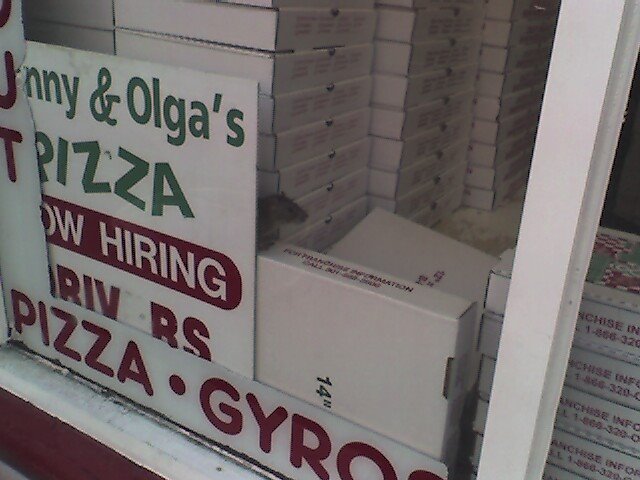
OMG I am never going to order food from Manny & Olga's! YYUUUKKK!! This picture was taken on 14th street. It's making me sick thinking of the food I have eaten from there over the years.
Homeless people in libraries.
http://www.tomdispatch.com/index.mhtml?pid=180836
This is a really interesting article that I tripped across earlier in the day. Pretty foul reading, eye opening though; hope your done eating.
This is a really interesting article that I tripped across earlier in the day. Pretty foul reading, eye opening though; hope your done eating.
Marx Cafe tonight!
Hey it's almost Tuesday nite again, so for me that indicates a trip to the DJ booth at the Marx Cafe is right around the corner. Hope to see you there!
Music starts at 9pm.
3203 Mount Pleasant St. NW
Music starts at 9pm.
3203 Mount Pleasant St. NW
Copper theft is serious business
This theft amazes me, and it's only going to get worse if copper prices continue their upward trend. I wish this report would have included the other side of this type of transaction; who are these theives selling their purloined wire to? Someone is buying their booty, otherwise there isn't much incentive to steal it in the first place. There's a copper fence market then, some unscruplous smelter no doubt.
Network World's LANs & Routers Newsletter, 04/03/07
Copper theft is incredibly widespread
By Jeff Caruso
Who knew that the copper wiring in your network was such an investment? Thieves everywhere are stealing copper as prices for the commodity have stayed at high levels - and they're risking their lives to get it.
Blame China. Apparently the country's rapid economic growth is behind the huge worldwide demand for copper. According to a Bloomberg article this week, demand for copper in China may increase as much as 10% this year. Prices will reach $3.50 per pound in the next few weeks, and may soon rebound to the record of $4 set last year.
Last week the Lowell (Mass.) Sun reported that two men were electrocuted when they allegedly tried to steal copper wiring from a transformer in Tyngsboro, Mass.
These were not the sharpest tools in the shed. They had applied bolt cutters to a wire that carried 13,000 volts, according to the paper.
Stealing copper is, of course, rampant. Over a year ago I relayed the news of 130 light poles that had been stolen from Baltimore streets because they were filled with electrical wires. But there are tons of more recent examples.
In Memphis last week, WREG-TV (Memphis) reported that thieves had been stripping copper from air-conditioning units at local businesses. In a recent case, someone turned on a vandalized air conditioner, and the thieves had left loose wires in the wall - the resulting fire did $45,000 worth of damage to a beauty shop.
In Palm Springs, Calif., two were arrested this week for allegedly stealing copper from wind towers. In Honolulu, experts this week estimated it would cost taxpayers a million bucks to replace the 225 light poles stolen from the sides of Hawaiian freeways. Police said the value of the stolen copper was about $420,000.
I could go on and on.
Now the target is mostly large electrical equipment, where the most copper is, so your Cat-5E copper wiring is probably pretty safe. But hey, you never know. How 'bout that fiber?
Monday, April 02, 2007
EV event in DC
This sounds like something i might be interested in. Going to try and check it out!
The Electric Vehicle Association of Washington, DC and the National Electric Drag Racing Association are putting on an exhibition of electric vehicles and their capabilities called the Power of DC. The event has been held for the last six years at the Mason-Dixon Drag Way in Hagerstown, Maryland. This year, the seventh year of the event, we are adding an autocross event the day before the drag race. This will be an EV autocross event, (dubbed EVautoX). The EVautoX will take place at Hagerstown Community College June 2nd, admission is free. The electric vehicle drag race event will take place at the Mason Dixon Drag Way on June 3rd, spectator admission is $5.
Because of the added event of the EVautoX, the Power of DC organization is in need of sponsors. There is growing interest in plug-in vehicles and this is the closest sanctioned event of its kind to Washington, DC. Sponsors of significance will have their logo placed on the events official T-shirt.
The Power of DC is mainly an exhibition demonstrating the speed and power that can be achieved using electricity as a fuel. What better way to show the acceleration capabilities of electric vehicles than through a drag race. The drag race has helped to dispel the sometimes common perception that electric vehicles are slow off the line. This year the Power of DC will be showing electric vehicles maneuverability, range and look through the EVautoX, which tests electric vehicles in slalom like timed courses, range courses and in a beauty contest called the Show-n-Shine.
At the demonstrations we will have a super efficient, super aerodynamic, and super light weight EV called the AZTEC. This vehicle was the winner of the commuter category in the 1994 American Tour de Sol. The University of West Virginia will be bringing its electrically powered Formula race car, (called a Formula Lightning when electric). The Formula Lightning vehicle can reach speeds up to 145 miles an hour on a race track without any pollutants coming from the vehicle. There will be other vehicles there to see and to touch, such as a solar panel clad Destiny 2000, a convertible Cabriolet, a few home converted Ford Escorts, a Toyota built RAV4 EV, and a Solectria Force. All vehicles that are worth coming to the show to see touch and ask the owners questions about. There will also be vehicles built by high school students, such as the Miramar 944 Porsche, and Shawn Lawless's famous Orange Juice dragster, as I said plenty of vehicles to see and touch. But there is more to the electric vehicle movement than just electric vehicles.
The electric vehicles movement is part of the larger alternative fuels movement. There will be demonstrations of solar panels, solar ovens, evacuated tube water heating and more. We still have room for exhibitors, so the door is open for organizations and companies to display their alternative fuel and energy products at the events.
Even though the Power of DC is a well attended event, this year our hope is to make it even bigger. We are asking that all schools, high schools, colleges, universities, and all organizations that are working on alternative fuels and electric drive trains, if they have products or vehicles to showcase to bring them to the event. We would really like to see a solar powered vehicle, one that was built to compete in competitions like the World Solar Challenge to be displayed at the event. We believe that advanced battery manufacturers and researchers would find a welcome home at these events. Organizations that are developing and selling electric motors for the hybrid and plug-in markets would be in line with the theme of the event. Automobile manufacturers exhibiting their hybrid technology would be a perfect fit. What ever you have that you feel the public should know about in terms of automotive advanced technology, alternative fuels and alternative energy contact us. I am sure we can make room for you in the event.
So, we need your assistance. First thing we would like you to do is spread the word about the Power of DC. Come and be there your self, bring family members, tell friends to make a weekend of it and come and have a good time. The second thing we need help on is finding sponsors. If you know of an organization or company that would be interested in beefing up its green credentials, here is their opportunity. The Power of DC is that event that has vast popular appeal, from the environmentalist to the automotive gear head, from the peace nick to the security hawk, the Power of DC brings all these groups together on common ground. Sponsoring our event upsets no one. Thirdly, bring your stuff. If you have an electric vehicle or an alternative fueled vehicle of any kind, bring it to the event. If you work in batteries, electric motors, controllers, capacitors or power electronics, bring it to the event and show it off. We welcome you. If you are in the solar panel, solar hot water heating business, if you sell high efficiency appliances, super insulation, bring it to the show. EV people tend to purchase those things also to the tune of 40%. For example, 40% of electric vehicle owners in California also have solar panels on their homes. It is precisely the market you are looking for. Car dealers, if you have hybrids of any kind, whether they be small cars to large trucks, this is the place to be. Show electric vehicles owners need to tow their vehicles long distances for shows. A hybrid truck is just the thing to bring to such an event. If you bring it, we will make room for it. In the end what we need is to bring your selves and your friends and family, bring sponsors, and bring your stuff. With that the Power of DC will become the catalyst to making the world better for our children and our children's children, but we will be having so much fun doing it, too.
For more information on this exciting EVent visit our website at
http://www.powerofdc.com
To Register, fill out our convenient Registration Form at
http://www.powerofdc.com/lets_race.html
A downloadable file of the EVent flyer is available at
http://www.powerofdc.com/powerofdc_flyer.pdf
For sponsorship opportunity contact Chip Gribben the organizer of the
Power of DC
futurev@radix.net
240-687-1678
For EVautoX information contact Mike Harvey
info@harveyev.com
And if you don't know who to contact, contact me and we will figure it
out.
Joe Lado
joelado@yahoo.com
Thursday, March 29, 2007
back stabbing saudi royal people
What??! I thought these guys were on our side.
The Saudi monarch has made a forceful appeal for Arab unity, denouncing US policy in Iraq and the embargo imposed by western nations on the Palestinians.
At the Arab League summit in Riyadh, King Abdullah described the US presence in Iraq as an illegitimate occupation.
Correspondents say he is seeking to show a measure of independence from Saudi Arabia's ally, the United States.
Arab leaders are meeting to relaunch a plan for peace with Israel that they first endorsed five years ago.
The plan offers Israel normal relations with Arab states if it withdraws from land occupied in 1967, and accepts a Palestinian state.
Arab hard-liners have accused Riyadh of being ready to water down the "land for peace" deal to gain Israeli acceptance.
Israel's western allies have withheld recognition from a new Palestinian unity government, including members of the Islamist group Hamas which they consider a terrorist organisation.
Abhorrent
The Saudi monarch insisted said the "real blame" for Arab woes lay with squabbling Arab rulers, who could only prevent "foreign powers from drawing the region's future" if they united.
"In beloved Iraq, blood is flowing between brothers, in the shadow of an illegitimate foreign occupation, and abhorrent sectarianism threatens a civil war," said the king.
"In wounded Palestine, the mighty people suffer from oppression and occupation," he said.
"It has become vital that the oppressive blockade imposed on the Palestinians end as soon as possible so the peace process will get to move in an atmosphere without oppression."
"Our constant disagreements and rejection of unity have made the Arab nation lose confidence in our sincerity and lose hope."
A US official has insisted King Abdullah was wrong to criticise the US military presence in Iraq.
"The United States is in Iraq at the request of the Iraqis and under a United Nations mandate. Any suggestion to the contrary is wrong," said National Security Council spokesman Gordon Johndroe.
Guarded welcome
Separately, Israel's Deputy Prime Minister Shimon Peres said it refused to accept the revived Arab peace plan as it stood and further discussions were needed.
"There is only one way to overcome our differences, and that is negotiation," Mr Peres told Israeli public radio. "It's impossible to say: you must take what we offer you as is."
Under the plan, Arab nations would recognise Israel if Israel withdrew from land occupied in the 1967 war, accepted a Palestinian state, and agreed a "just solution to the Palestinian refugee problem".
Israel rejected the 2002 plan outright after it was first proposed at an Arab summit in Beirut, but Israeli Prime Minister Ehud Olmert is now giving it a guarded welcome, albeit with reservations linked to the issue of refugees.
There are more than four million Palestinian refugees registered with the US, most of them descendants of people living in British-administered Palestine, before Israel was created in 1948.
Israel opposes allowing them to exercise any right to return to their original homes or land, because it could erase its current Jewish majority.
Tuesday, March 27, 2007
marx cafe tonite!
I'll be at Marx Cafe tonite playing some classic garage, 2step and 4x4 bassline. Mention that you know where the treasure has been buried and I'll buy you a couple of drinks. Music starts at 10pm. Seeya tonite!
3203 Mount Pleasant St. NW
3203 Mount Pleasant St. NW
Friday, March 23, 2007
Why no Impeachment??
I really hope that Dave here is wildly off the mark. If not this would represent a truly cynical political manipulation of our armed forces involved in the fight in Iraq.
Why Haven't They Impeached Bush (and Cheney) Yet?
* ImpeachForChange
By Dave Lindorff
After a year of running around flogging my book The Case for Impeachment (St. Martin’s Press, 2006), I’ve had to give a lot of thought to a question I have gotten over and over from radio hosts to ordinary people concerned about the fate of the country and our Constitution. The question: Why haven’t the Democrats already impeached the president for all these crimes, abuses of power and assaults of the Constitution?
I used to chalk it up to cowardice, but I’m no longer happy with that answer. House Speaker Nancy Pelosi (D-Calif.) may be a politician’s politician, but she hasn’t lacked for courage. She has, for example, always been ready to stand for taking a tough line on civil liberties in China, when the corporatocracy has been pressing the government to cozy up to China.
It’s also hard to buy the idea that so many progressive members of the House--people like John Conyers (D-Mich.), Charles Rangel (D-N.Y.), Chakka Fattah (D-Penna.) and Maxine Waters (D-Calif.)--all of whom clearly understand the nature of the president’s crimes, could be afraid to submit bills of impeachment--indeed that all the progressive members of the Democratic Party in the House are so afraid to take a stand on impeachment that not one has dared to submit an impeachment bill. (Only Cynthia McKinney (D-GA) has taken that step, and she waited until she had already been voted out of office and then filed her impeachment bill in the last week of the 109th Congress.)
That said, there are some things I do know.
First of all, there are members of Congress who understand that the president should be impeached. Chief among these is Rep. Conyers. Back in the last Congress, Conyers, as ranking minority member of the House Judiciary Committee--the committee that would hold impeachment hearings if a bill of impeachment were submitted--held unofficial hearings into some of the president’s high crimes and misdemeanors, which resulted in a book, George W. Bush Versus the U.S. Constitution: The Downing Street Memos and Deception, Manipulation, Torture, Retribution, Coverups in the Iraq War and Illegal Domestic Spying. The book is a clear call for impeachment. Conyers also filed a bill in the 109th Congress which called for creation of a “select committee” to investigate possible impeachable crimes by the Bush administration. It ultimately boasted 39 co-sponsors, including Reps. Rangel, Fattah and Waters.
I also know that midway through the 2006 election year, Rep. Pelosi began telling reporters, at every opportunity, that if Democrats were elected to a majority in the House in the November election, there would be no impeachment effort--impeachment, in her words, would be “off the table.”
And so it has been, at least inside the Beltway. And not only has it been put off the table--Pelosi and the party leadership have been actively working behind the scenes in an unconscionable effort to undermine grassroots campaigns to put it back on, via state legislative resolutions. In both New Mexico and Washington state, Democratic party leaders from Washington have put the screws on local legislative leaders to keep the issue of impeachment from even making it to an open floor debate in a legislative chamber. Clearly, progressive members of Congress have also been pressured not to submit impeachment bills.
In part, I think this is all happening because Pelosi and the rest of the Democratic Party leadership have bought the Republican Party’s spin--that impeachment would be “good for Republicans” because it would allegedly “energize the Republican base” that supports President Bush no matter what. Maybe that is technically true, but that base is less than 30 percent of the voting public, and it ignores that fact that impeachment would also energize the Democratic, progressive base, and might well also energize the libertarian base, all of which collectively would far outnumber any possible energized reactionary base.
This leads me to what I think is the real reason the Democratic leadership is opposing impeachment--a reason I find thoroughly disgusting and unworthy of the party of Roosevelt.
I believe that Pelosi, Sen. Harry Reid (D-Nev.), Sen. Chuck Schumer (D-N.Y.), Rep. Rahm Emanuel (D-Ill.), Howard Dean and the rest of the leaders of the Democratic Party, have concluded that the Republican Party and the Bush administration have so screwed up that they have lost the support of the majority of Americans, and that all Democrats need to do to win the White House and a bigger margin in the House and Senate in 2008 is to let them continue to screw up, aided by selective Congressional investigations designed to further embarrass them.
While Pelosi has talked grandly about passing a progressive agenda of bills in the 110th Congress, the Democrats know that they cannot pass any meaningful progressive legislation. Their majority in both houses is razor thin and could never survive a veto, and even if they could, by watering down their bills, lure enough Republican votes to override a veto, President Bush would invalidate any bill that made significant change or reform by just issuing one of his unconstitutional and illegal “signing statements” asserting that as commander in chief in the war on terror he doesn’t have to adhere to the Constitution.
So what Pelosi and Senate Majority Leader Reid plan to do is pass legislation that they know won’t go into law, like the minimum wage bill, or global warming laws, and then go to the voters in 2008 saying, “We would have gotten these bills into law, if only we had more Democrats in the Congress, or a Democratic president.”
They’re doing the same thing with the war. If Democrats wanted to end the war, they could do so immediately by refusing to pass a supplemental funding measure to support it, but they don’t want to do this. It’s not that they fear being called unpatriotic--hell, with 70 percent of the public wanting the war to end immediately, nobody would fault Congress for pulling the plug. Even the troops who are stuck over there wouldn't be upset to see the funding that keeps them there terminated. But ending the war would leave the Democrats without their best issue going into the 2008 national election: Bush’s war. So instead of ending the war, they vote to oppose it, but then continue to fund it. (Rep. Emanuel has actually said publicly that it would be good for Democrats if the war were to continue through November 2008.)
It’s a supremely cynical campaign ploy, and it’s also behind the strategy of keeping impeachment “off the table.”
If Bush were impeached, and witnesses began getting called in under oath to expose his and Vice President Dick Cheney’s lies and deceit in tricking the nation into war, his illegal NSA spying activities, his obstruction of justice in the Valerie Plame outing investigation, his authorization of torture, his obstruction of efforts to combat global warming, his criminal failure to provide troops with armor or to plan for an Iraq occupation or to respond to the disaster in New Orleans, and his usurpation of the powers of Congress and the Judiciary in invalidating over 1200 laws passed by the Congress, it would almost certainly lead to his (and Cheney’s) removal from office and to a prompt end to the war.
Then where would Democrats be?
They’d have to stand on their own merits. They’d have to give voters a positive reason to vote for them.
And it’s been so long since Democrats have done that that they really may not even know how it’s done.
Even progressive Democratic representatives seem to have bought into this cynical thinking. How else to explain Rep. Conyers’ repudiation of his own book, even as it’s about to come out in paperback? How else to explain the deafening silence of progressives like Reps. Waters, Rangel, Jesse Jackson Jr., and, at least until this week, Dennis Kucinich?
I’m hoping that at least Kucinich will finally stand up and reject this cynical Democratic thinking, and file a bill of impeachment, giving Rep. Conyers the chance to redeem himself by standing up to Pelosi et al. If he does stand up, and begins hearings on an impeachment bill, I hope other progressive Democrats—and maybe a few principled Republicans?--will join him by filing their own impeachment bills. I hope state legislators in Vermont, Washington state, New Jersey and elsewhere, will take heart from what Kucinich appears ready to do, and will shrug off the pressure from Democratic national leaders, listen to their own residents, and pass joint resolutions calling for Congress to initiate impeachment hearings, too.
This dam can be broken.
If it is, perhaps Democrats and patriotic Republicans will finally be able to live up to their oaths of office, which pledge them to uphold and defend the Constitution “against all enemies foreign and domestic.” There is no greater enemy of Constitutional government, the rule of law, and the freedoms that so many have died to establish and to defend than President Bush and his administration. If Congress will not stand up to the crimes of this administration and call this president to account through impeachment, all future presidents will feel free to follow his corrupt example, and the impeachment clause may as well simply be removed from the Constitution.
Or be rewritten to refer only to lies about extramarital sex.
-----------------------
DAVE LINDORFF is co-author, with Barbara Olshansky, of "The Case for Impeachment: the Legal Argument for Removing President George W. Bush from Office (St. Martin's Press, 2006). His work can be found at www.thiscantbehappening.net and at www.counterpunch.org
Thursday, March 22, 2007
big surprise: TJX data theft earns for criminals
Wasn't this exactly what TJX officials said couldn't be done with the stolen/lost data right after going public with the news of the breach?
Stolen TJX Data Used in $8M Scheme Before Breach Discovery
By Evan Schuman, Ziff Davis Internet
March 21, 2007
Information stolen from the systems of massive retailer TJX was being used fraudulently in November 2006 in an $8 million gift card scheme, one month before TJX officials said they learned of the breach, according to Florida law enforcement officials.
The significance of this new TJX detail—discovered as Florida authorities issued arrest warrants for 10 suspects and took six of them into custody—is not clear, but it might yield clues as to how TJX learned of the breach.
The $16 billion retail chain has officially said that a huge amount of information was accessed as early as 2005 (with some of the captured data dating back to 2003), but that TJX officials didn't learn of the breach until December 2006. The company didn't announce the breach until mid-January 2007 due to—according to one credit-card source—a request from the Secret Service because it was actively pursuing a suspect.
The Florida information raises the possibility that whoever took the data had decided to start using it late last year. Law enforcement pursuing those cases would have found TJX as the common link, potentially prompting TJX to more closely examine its systems.
In the Florida case, a group used TJX credit- and debit-card information to do a low-tech clone scam to the tune of about $8 million. The group is accused of taking credit cards and applying new magstripes containing the stolen data. It is not clear if the credit cards displayed the same numbers in plastic embossing that were in the magstripe, said Dominick Pape, the special agent in charge for the Florida Department of Law Enforcement.
Florida officials released the names of the six suspects who were arrested: Irving Escobar, 18; Reinier Camaraza Alvarez, 27; Julio Oscar Alberti, 33; Dianelly Hernandez, 19; Nair Zuleima Alvarez, 40; and Zenia Mercedes Llorente, 23. Four others are still at large, Pape said.
The group has been charged with an organized scheme to defraud, and they are also being investigated by the Secret Service, which participated in the arrests.
Florida officials said the group used the increasingly common tactic of using the bogus credit cards to purchase gift cards and then cashing them at Wal-Mart and Sam's Club stores. The group usually purchased $400 gift cards because when the gift cards were valued at $500 or more, they were required to go to customer service and show identification, Pape said.
The gift card float technique is attractive to thieves because it buys them more time. When a credit card is stolen and detected by the victim, it's only a matter of hours before the card will be invalidated.
But if the thief immediately uses the card to purchase gift cards, it buys the thief a significant amount of time. Once the credit card is deactivated, it may take days or weeks before authorities learn what was purchased—down to the exact identification number of those gift cards—and then start invalidating those gift cards.
Florida authorities have video of their suspects from both inside the store and outside. Videotape captured the license plate of a rented vehicle one of the suspects was driving. Items purchased included computers, gaming devices and big-screen televisions, police said.
At this stage, authorities are hoping to press the group to identify where they got the card data, in hopes that it will ultimately lead them to the cyberthieves who struck TJX. Pape said it is unlikely that the 10 suspects are the ones who attacked TJX. "We do not have information today that they were at the high end of the compromise," he said.
In other TJX news this week, a TJX shareholder—the Arkansas Carpenters Pension Fund—is suing TJX to access records showing how TJX handled data security.
Retail Center Editor Evan Schuman can be reached at Evan_Schuman@ziffdavis.com.
Tuesday, March 20, 2007
marx cafe tonite!
That's right, it's Tuesday; AGAIN! Seems like this thing happens once a week weather I like it or not. It's an unstoppable force; time that is. i have a bunch of new music that I didn't get an opportunity to play last week.
Seeya tonight! Music starts at 10pm.
3203 Mount Pleasant St. NW
Seeya tonight! Music starts at 10pm.
3203 Mount Pleasant St. NW
Clear headed analysis
Wow, this article was posted on Military.com; how far we have come in a couple of years. Even a year ago I think it would have been unthinkable to see these sentiments displayed so openly. Perhaps after this whole episode is over our country will learn to shy away from military adventurism and foreign conquest and instead focus on our priorities here at home.
Playing the Course
Jeff Huber | March 19, 2007
Those who can make you believe absurdities can make you commit atrocities. --Voltaire
The peculiarly insane brand of neoconservative pro-war rhetoric continues to resonate. Last week, Representative C.W. Bill Young (R-FL) said, "Nobody wants our troops out of Iraq more than I do, but we can't afford to turn over Iraq to al-Qaida."
The Sunni organization al-Qaeda is not going to take over Shiite dominated Iraq. If Young honestly thinks it can, he's an utter dullard. It's more likely that Young was the Bush liegeman chosen to introduce the latest Rovewellian talking point.
Straying the Course
From the beginning, The administration and its echo chamberlains have sold their woebegone war in Iraq with a fabric of glittering generalities, appeals to emotion, bandwagons, sand bagging, blame shifting, straw man attacks, faulty main assumptions, false analogies, and the rest of the propaganda arsenal. They coaxed us into this war by making visions of mushroom clouds dance in our heads, and they've been playing Rovewellian mind games with us ever since.
Their most enduring trick has been the "fighting them over there so we don't have to fight them over here" mantra. In recent months "fighting them over there" has morphed into "If we withdraw, they will follow us here." Pish. How are they going to get here--hide in our troops' luggage? Swim? Wind surf? Jump?
Despite what Bush the younger tells us, the oceans do, in fact, still protect us. Nobody has an army large enough to invade and occupy the United States, and they certainly don't have a navy or air force capable of transporting a force that size across the Atlantic or Pacific. Even if they did, we could sink them and/or shoot them down before they got halfway here.
Yes, terrorists might still sneak through our borders and ports in drips and drabs like the 9/11 perpetrators did, but nothing we're doing militarily in the Middle East is preventing that from happening. That's Homeland Security's job, and if Homeland Security can't keep terrorists from infiltrating our country, why does it even exist?
Young Mr. Bush exhorts us to show "resolve" in the Middle East. But the kind of resolve we're showing in the Middle East is the kind of resolve it takes to throw yourself in front of a moving bus, and then lie there while the bus continues to roll back and forth over you.
In January, Senator Joe Lieberman (?-CT) said on Meet the Press that "We all want to find the right exit strategy. But my own sense of history tells me that in war, ultimately, there are two exit strategies. One is called victory; the other is called defeat."
My three dogs have a better sense of history than Lieberman does. Wars, especially modern American wars, have seldom been decisive. World War I ended in an armistice, the conditions of which laid the groundwork for World War II. World War II concluded with the formal surrenders of Germany and Japan, but that only led to the Cold War and a series of dirty little third-world proxy wars that lasted for half a century.
One pro-war neoconservative pundit recently compared Representative Jack Murtha (D-PA) to Lee Harvey Oswald. He said that Murtha and Oswald formed a small club of individuals who deserved to be classified as "ex-Marines." This pundit is not a Coulter-class luminary in the neoconservative galaxy. He is a distinguished dean and professor at one of our most distinguished graduate level war colleges who consistently indulges in this kind of vituperative through the Big Brother Broadcast megaphone. With people like him in key positions of upper level of military academia, it's little wonder our national security brain trust is so bankrupt.
We hear from voices on the right that a U.S. withdrawal from Iraq will create conditions that could lead to a regional war, but the fact is that U.S. presence in Iraq has created a regional war. Conflict, at one level or another, rages from the Horn of Africa to Pakistan, and our presence in Iraq is fueling it, not containing it.
The Bush war hawks keep serving up grape flavored hallucinogen shooters, and their non-cognitive supporters keep slamming them down. Meanwhile, a pack of dune farmers armed with tinker toys continue to make the "best-trained, best-equipped" armed force in history look like it couldn't find its oasis with a map and a flashlight.
It's so difficult for me to watch our chicken hawk leaders pour more of our magnificent troops into a war they're not designed to fight in pursuit of a "victory" that cannot be defined, and justify their policies and strategies with arguments they have to know are medicine show hokum, and blame their failures on the CIA, the news media, Catholics who voted for John Kerry, and whatever other scapegoat is handy.
It breaks my heart.
Tuesday, March 13, 2007
marx cafe tonite!
Yes sir! I'll be at Marx tonite playing from 10pm until 2am. I have a whole batch of fresh tunes to try out, so it should be good times. Mention this blog and I'll buy you some drinks. Seeya there!
3203 Mount Pleasant St. NW
3203 Mount Pleasant St. NW
Casting call for national Treasure 2
Why make a NT2 when the first film was so awful? Do they think they will get it right this time? lol
National Treasure 2 Open Call in DC Monday the 19th
CARLYN DAVIS CASTING IS CALLING ALL MEMBERS WHO ARE AVAILABLE FOR BACKGROUND WORK ON NATIONAL TREASURE II
There will be a huge open call this Monday the 19th from 3:00 until 7:00pm.Location: McFadden’s Restaurant on the corner of 24th and Pennsylvania Ave. NW. Parking is on the street and Metro is the Foggy Bottom stop about 2 ½ blocks from McFadden’s.The entire Casting Team will be there. Come join the fun! McFadden’s will be showing National Treasure 1 on Monday night.
All you need to do is bring a headshop OR current snap shot of yourself.For up to date information, keep checking www.carlyndaviscasting.com (c-a-r-l-y-n) and www.mcfaddensdc.com . Look forward to seeing you on the big screen, Washington!
National Treasure 2: The Book of Secrets" Starring Nicholas Cage, Diane Kruger, Jon Voight, Harvey Keitel and Justin Bartha.
We will be needing the following types for background work:
- Cigar smokers (Senators) & White House Staff Types
- Secret Service and FBI types
- Good Drivers w/Cars (not black, white, red or yellow)
- Military to include 2 Generals and 1 Major
- Catering Waiters/Waitresses, Chefs and Bartenders (experience a plus)
- George and Martha Washington look-alikes
- Diplomat couples in formal attire (authentic Scottish, African, Japanese, French and Middle Eastern costumes)
- Beautiful Model types 25-40 in age for a formal scene
- Formal types-ladies in FULL length dresses, men in Tuxes
- Bomb Detection Units w/dogs
- Bike Messengers (experience a plus)
- College students including 20 skateboarders and some hacky sackers
- University Professors
- Security Guards and Police
- Lots of Business and Tourist types
- Librarians
- Joggers (female)
- Dog Walkers w/ dogs
- Senior Citizens
- Bicyclists w/ bikes
- 18 and older who look 15-17
- Park Rangers
- Teachers
- Rich Texans
- String Quartet
Friday, March 09, 2007
Northern State at Black Cat
OMG OMG!! I will be there, these girls are AWSOME!! I'll have to suck it up and return to the black cat, last time I went there i didn't have a very good time.
UPCOMING SHOWS (See list of past shows)
* Monday March 12, 2007
Washington DC
The Black Cat
1811 14th St. NW
Washington DC, 20009
202.667.7960
9 pm
$10
http://www.blackcatdc.com/schedule.html
w/ Bitch and The Exciting Conclusion
Tuesday, March 06, 2007
Happy John Frum day!!!!1
This is amazing, one day I will complete the trek; and celebrate this fine holiday with the people of Sulphur Bay.
A Christian youth worker told me how he thought the cult was childish. "It's like a baby playing games," he insisted. "Those people are holding on to a dream that will never come true," he said.HA HA HA HA, oh.. Irony; this is your name.
Cargo cult lives on in South Pacific
By Phil Mercer
BBC News, Tanna, Vanuatu
At the base of a sacred volcano in an isolated corner of the South Pacific young men play the "Star Spangled Banner" on bamboo flutes.
Men march with the US flag
Islanders have celebrated John Frum's generosity for 50 years
Every February they parade in old US army uniforms with wooden weapons.
Others go bare-chested with the letters "USA" painted in bright red letters on their bodies.
Nearby, a giant Stars and Stripes flutters in the breeze from the main flagpole.
This is the heart of John Frum country on the island of Tanna in Vanuatu.
Villagers at Sulphur Bay worship a mystical figure who they believe will one day bring them wealth and happiness.
Time of upheaval
"John is our god," declares village chief Isaac Wan, who beats his fists into the ground to emphasise his words.
"One day he will come back," he says.
Believers are convinced that John Frum was an American.
The name could well have come from war-time GIs who introduced themselves as "Jon from America."
Devotees say that the ghost of a mystical white man first appeared before tribal elders in the 1930s.
It urged them to rebel against the aggressive teachings of Christian missionaries and the influence of Vanuatu's British and French colonial masters.
The apparition told villagers to do all they could to retain their own traditions.
Anthropologist Ralph Reganvalu told the BBC that the sect was a "cultural preservation movement" that was born during a time of upheaval.
"There was a whole period in history known as Tanna Law where the missionaries put in this series of rules about what people weren't supposed to do and the movement emerged because of this oppression," he said.
Homage to the US
World War II and the arrival of US troops on Vanuatu was a defining time for the movement. They had a name for their spiritual deity. He was John Frum.
Villagers believe that their messiah was responsible for delivering to them the munificence of the US military.
They were awestruck by the army's cargo of tanks, weapons, refrigerators, food and medicine.
John Frum day is held annually on 15 February. This year's celebration marks the 50th anniversary of the sect's formal establishment.
It also recognises the day when villagers raised the US flag for the first time.
Through this homage to the US, disciples hope their ethereal saviour can be encouraged to return.
"It's a little bit weird but it makes me feel really patriotic," said Marty Meth, a retired businessman from New York, who had travelled to Tanna to see the festivities.
"It's really nice to see Americans welcome here since in so many places in the world we're not so welcome these days," he added.
Many followers of John Frum believe his spirit lives deep within the volcano.
Every few minutes Yasur bellows.
Watching and listening from the crater's edge is both exhilarating and frightening. A deafening growl is followed by the blasting of molten rock high into the sky.
These rumblings are a constant reminder for villagers that the spirit of John Frum remains as potent as ever.
About 20% of Tanna's population of 30,000 follow the teachings of one of the world's last remaining cargo cults.
Other islanders can barely disguise their contempt for it.
A Christian youth worker told me how he thought the cult was childish. "It's like a baby playing games," he insisted. "Those people are holding on to a dream that will never come true," he said.
I put this view to Rutha, who's married to Chief Isaac's son. She was unfazed.
"I don't care what they think," she says gently without a hint of displeasure. "John is our Jesus and he will come back."
The John Frum Movement is still trying to entice another delivery of cargo from its supernatural American god.
In the meantime his disciples continue to wait and hope.
Marx Cafe tonight!
Another Tuesday; another opportunity to get wild without the weekend! I'll be spinning from 10-2, you know where.
3203 Mount Pleasant St. NW
3203 Mount Pleasant St. NW
DOD; global warming real, will destroy us all
Wow, this is not good news at all. Time to go to code red!
Now the Pentagon tells Bush: climate change will destroy us
Mark Townsend and Paul Harris in New York
Sunday February 22, 2004
The Observer
Climate change over the next 20 years could result in a global catastrophe costing millions of lives in wars and natural disasters..
A secret report, suppressed by US defence chiefs and obtained by The Observer, warns that major European cities will be sunk beneath rising seas as Britain is plunged into a 'Siberian' climate by 2020. Nuclear conflict, mega-droughts, famine and widespread rioting will erupt across the world.
The document predicts that abrupt climate change could bring the planet to the edge of anarchy as countries develop a nuclear threat to defend and secure dwindling food, water and energy supplies. The threat to global stability vastly eclipses that of terrorism, say the few experts privy to its contents.
'Disruption and conflict will be endemic features of life,' concludes the Pentagon analysis. 'Once again, warfare would define human life.'
The findings will prove humiliating to the Bush administration, which has repeatedly denied that climate change even exists. Experts said that they will also make unsettling reading for a President who has insisted national defence is a priority.
The report was commissioned by influential Pentagon defence adviser Andrew Marshall, who has held considerable sway on US military thinking over the past three decades. He was the man behind a sweeping recent review aimed at transforming the American military under Defence Secretary Donald Rumsfeld.
Climate change 'should be elevated beyond a scientific debate to a US national security concern', say the authors, Peter Schwartz, CIA consultant and former head of planning at Royal Dutch/Shell Group, and Doug Randall of the California-based Global Business Network.
An imminent scenario of catastrophic climate change is 'plausible and would challenge United States national security in ways that should be considered immediately', they conclude. As early as next year widespread flooding by a rise in sea levels will create major upheaval for millions.
Last week the Bush administration came under heavy fire from a large body of respected scientists who claimed that it cherry-picked science to suit its policy agenda and suppressed studies that it did not like. Jeremy Symons, a former whistleblower at the Environmental Protection Agency (EPA), said that suppression of the report for four months was a further example of the White House trying to bury the threat of climate change.
Senior climatologists, however, believe that their verdicts could prove the catalyst in forcing Bush to accept climate change as a real and happening phenomenon. They also hope it will convince the United States to sign up to global treaties to reduce the rate of climatic change.
A group of eminent UK scientists recently visited the White House to voice their fears over global warming, part of an intensifying drive to get the US to treat the issue seriously. Sources have told The Observer that American officials appeared extremely sensitive about the issue when faced with complaints that America's public stance appeared increasingly out of touch.
One even alleged that the White House had written to complain about some of the comments attributed to Professor Sir David King, Tony Blair's chief scientific adviser, after he branded the President's position on the issue as indefensible.
Among those scientists present at the White House talks were Professor John Schellnhuber, former chief environmental adviser to the German government and head of the UK's leading group of climate scientists at the Tyndall Centre for Climate Change Research. He said that the Pentagon's internal fears should prove the 'tipping point' in persuading Bush to accept climatic change.
Sir John Houghton, former chief executive of the Meteorological Office - and the first senior figure to liken the threat of climate change to that of terrorism - said: 'If the Pentagon is sending out that sort of message, then this is an important document indeed.'
Bob Watson, chief scientist for the World Bank and former chair of the Intergovernmental Panel on Climate Change, added that the Pentagon's dire warnings could no longer be ignored.
'Can Bush ignore the Pentagon? It's going be hard to blow off this sort of document. Its hugely embarrassing. After all, Bush's single highest priority is national defence. The Pentagon is no wacko, liberal group, generally speaking it is conservative. If climate change is a threat to national security and the economy, then he has to act. There are two groups the Bush Administration tend to listen to, the oil lobby and the Pentagon,' added Watson.
'You've got a President who says global warming is a hoax, and across the Potomac river you've got a Pentagon preparing for climate wars. It's pretty scary when Bush starts to ignore his own government on this issue,' said Rob Gueterbock of Greenpeace.
Already, according to Randall and Schwartz, the planet is carrying a higher population than it can sustain. By 2020 'catastrophic' shortages of water and energy supply will become increasingly harder to overcome, plunging the planet into war. They warn that 8,200 years ago climatic conditions brought widespread crop failure, famine, disease and mass migration of populations that could soon be repeated.
Randall told The Observer that the potential ramifications of rapid climate change would create global chaos. 'This is depressing stuff,' he said. 'It is a national security threat that is unique because there is no enemy to point your guns at and we have no control over the threat.'
Randall added that it was already possibly too late to prevent a disaster happening. 'We don't know exactly where we are in the process. It could start tomorrow and we would not know for another five years,' he said.
'The consequences for some nations of the climate change are unbelievable. It seems obvious that cutting the use of fossil fuels would be worthwhile.'
So dramatic are the report's scenarios, Watson said, that they may prove vital in the US elections. Democratic frontrunner John Kerry is known to accept climate change as a real problem. Scientists disillusioned with Bush's stance are threatening to make sure Kerry uses the Pentagon report in his campaign.
The fact that Marshall is behind its scathing findings will aid Kerry's cause. Marshall, 82, is a Pentagon legend who heads a secretive think-tank dedicated to weighing risks to national security called the Office of Net Assessment. Dubbed 'Yoda' by Pentagon insiders who respect his vast experience, he is credited with being behind the Department of Defence's push on ballistic-missile defence.
Symons, who left the EPA in protest at political interference, said that the suppression of the report was a further instance of the White House trying to bury evidence of climate change. 'It is yet another example of why this government should stop burying its head in the sand on this issue.'
Symons said the Bush administration's close links to high-powered energy and oil companies was vital in understanding why climate change was received sceptically in the Oval Office. 'This administration is ignoring the evidence in order to placate a handful of large energy and oil companies,' he added.
Subscribe to:
Posts (Atom)

